
Team
Team of 5 graduate researchers part of the User-Centered Research & Evaluation (UCRE) course
Designed For
Spotify listeners seeking transparency and control over AI-generated music in their listening experience.
Timeline
4 Months | August 2025 - December 2025
My Role
User Researcher
Tools + Technologies
Semi-structured interviews, think-aloud studies, Interpretation notes, affinity diagramming, Figma, Miro, Google Sheets
Problem
Lack of transparency around AI-generated music undermines user trust on Spotify.
As AI-generated music becomes more common on streaming platforms, many listeners are unaware of its presence and unsure of what they are hearing. This ambiguity creates confusion around authorship and raises concerns about authenticity and trust.
Key Insights

Background Research on Spotify Listeners


Semi-Structured Interviews & Think-Alouds
We conducted semi-structured interviews with 11 regular Spotify users, combining think-aloud tasks with directed questions to observe real listening behavior and probe assumptions about AI-generated music.

Interpretation Notes
After each session, we documented interpretation notes to capture early observations around emotional reactions, trust shifts, and decision-making cues.

Affinity Diagraming
We synthesized observations across participants using affinity diagramming to identify recurring themes and tensions around transparency, authenticity, and trust.


Modeling & Synthesis
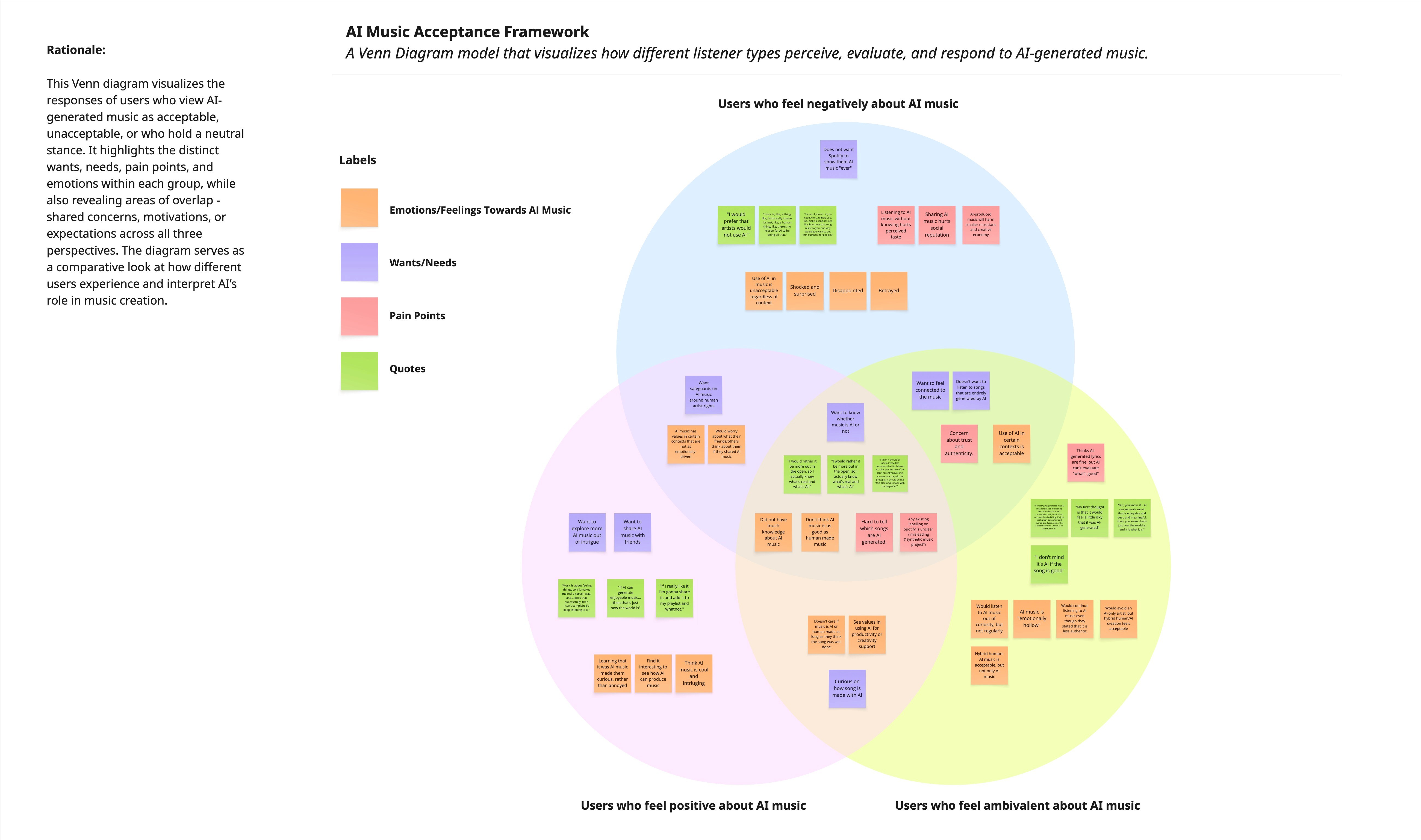
Spotify listeners held mixed attitudes toward AI-generated music:

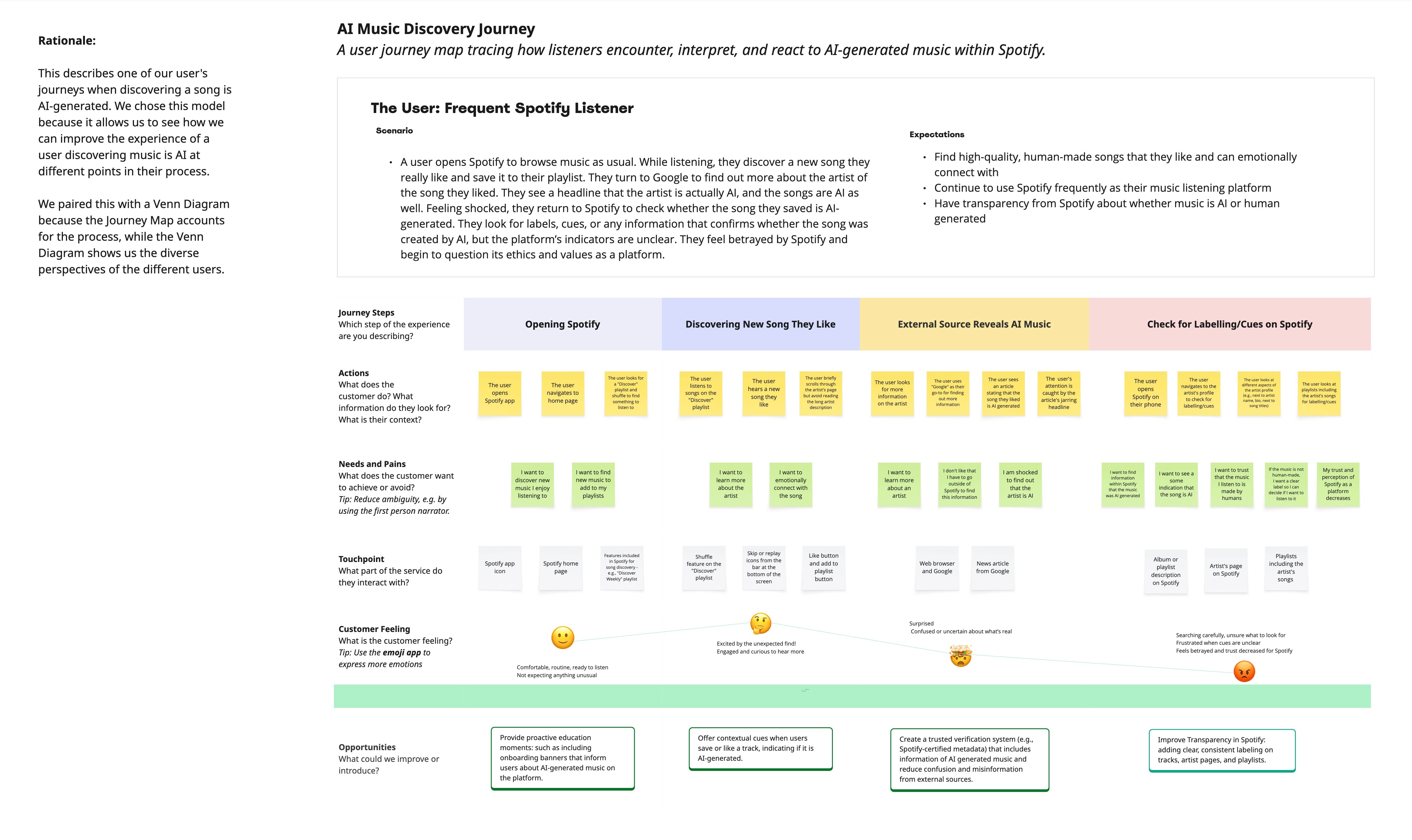
We translated these themes into higher-level models to better understand user mental models and identify opportunity areas for platform-level interventions.
Outcomes

Main Insight
AI transparency builds trust only when it gives users meaningful control over the AI they encounter, not just information.
Clear disclosure allows users who want to avoid AI-generated content to do so, while enabling others to explore it without undermining trust in the platform.
Lessons Learned
Different contextual research methods answer different questions.
Better probing leads to better insight.
Users were more open to AI-generated music than expected when they could control how much they encountered it.
Perceived Impact
Spotify listeners could better understand and control the presence of AI-generated music in their feeds without disrupting their everyday listening experience.

Acknowledgements
This project was completed as part of a graduate User-Centered Research and Evaluation (UCRE) course taught by Raelin Musuraca, Associate Teaching Professor (SCS, HCII). The research direction was informed by WeAudit / TAIGA, a project led by Hong Shen, Assistant Professor (SCS, HCII), which focuses on empowering users to identify and understand harmful behaviors in generative AI systems.
